Analysis

Sonaris

Audio Quality Analyzer

Is this file what it claims to be, and is it fit for where it is going?

This page describes Sonaris 1.0.2, published on 7 May 2026.

Sonaris scans and grades music libraries, production archives, masters and distribution catalogues. It measures the true frequency content of each track, compares it with what the codec and bit rate should deliver, and assigns a grade from S to F.

It keeps the gathering of evidence apart from the delivery decision. Analysis collects measurements across a library; Delivery Check holds one master against a published loudness specification; Compare Audio sets two masters side by side through the same measurement pipeline.

Quality grades
S–F
Audio formats
43
Delivery profiles
3
Compared measurements
18
File checksums
2
Report formats
3

Quality Grading

The grade reflects the highest frequency at which meaningful content is present, found by filtering the audio through progressively higher bands. Longer tracks that appear band-limited are checked again at their midpoint, and the stronger reading is kept.
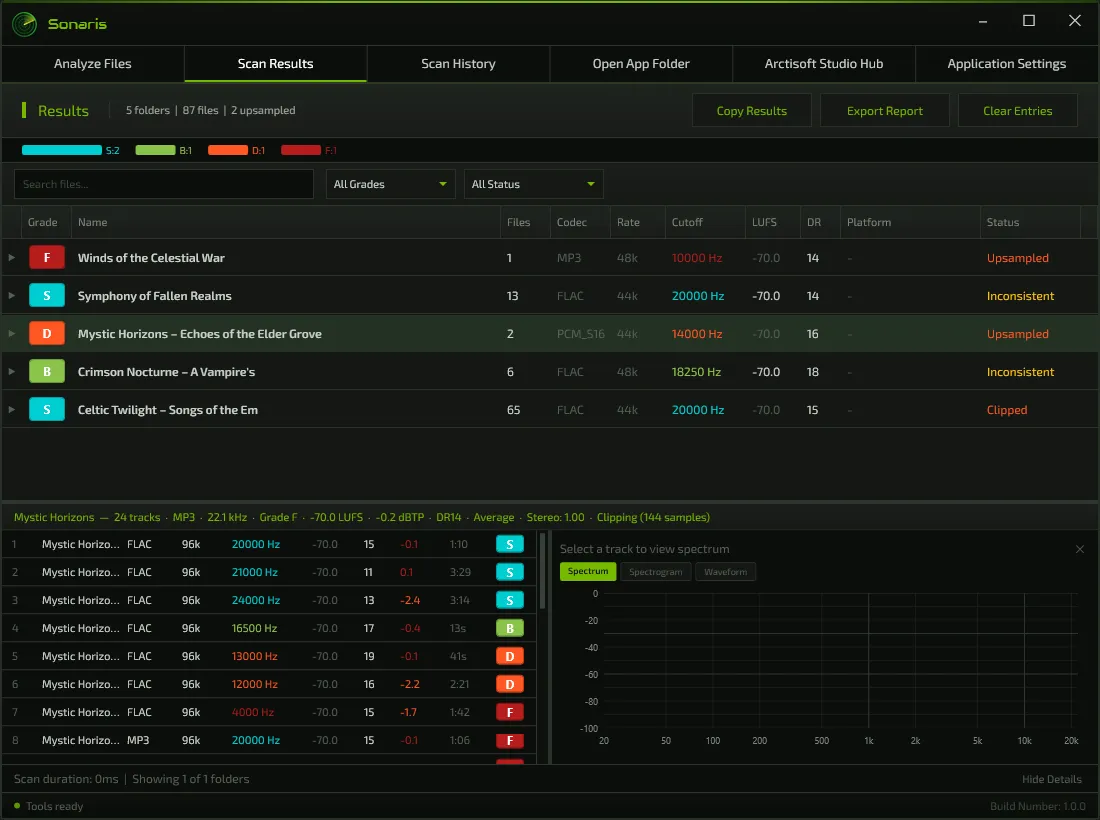
Sonaris scan results with grades, cutoff frequencies, loudness, dynamic range and a spectrum view
Scan results, with the spectrum of a selected track
Absolute grades by measured spectral cutoff
GradeCutoffMeaning
S20 kHz or aboveFull bandwidth, no perceptible loss
A18 kHz or aboveNear-transparent quality
B16.5 kHz or aboveGood quality
C15 kHz or aboveAcceptable for standard streaming
D12 kHz or aboveAudible high-frequency loss
FBelow 12 kHzSevere loss, speech-grade or damaged audio

Mastering Assessment

Independently of the frequency grade, each track is assessed on its loudness and dynamics: integrated loudness to EBU R 128, loudness range, dynamic range and true-peak headroom. A recording can have a flawless spectrum and still be marked down for heavy compression or clipping.

Mastering ratings
RatingFinding
ExcellentDynamic range of 12 or more, proper headroom, ideal loudness range
GoodDynamic range of 9 or more, minor headroom issues
AverageDynamic range of 6 to 9, typical modern commercial mastering
PoorDynamic range below 6, heavy compression
ClippedTrue peak at or above 0 dBTP, or clipped samples detected

Signal Integrity

The measurements that answer whether a file is honest: whether a lossless container holds lossy audio, whether twenty-four bits contain sixteen, whether the signal clips, and exactly where.

Upsampling
Flags lossy audio stored in a lossless container by comparing the measured cutoff with what the codec and bit rate should deliver.
Bit depth
Measures the effective resolution of 24-bit lossless files and marks padded 16-bit content.
Clipping
Counts samples at full scale, measures inter-sample true peak and reports the time windows that contain clipping.
Silence
Leading, trailing and mid-track silence, with durations and segment counts.
Stereo
Left/right correlation, identifying mono content, true stereo and phase inversion.
Multichannel
Loudness and peak for each channel of surround material, surfacing imbalances a downmix would hide.
Checksums
MD5 and SHA-256 for every analysed file, computed alongside the analysis.

Delivery Check

Choose a profile, choose a file, run the check. The result is a verdict with the failing checks named, the headline measurements, a chart placing the master inside the accepted range, and a table of each check against its requirement.

Delivery profiles
ProfileScopeProgramme loudnessTrue-peak ceiling
EBU R 128European broadcast−23 LUFS (−23.5 to −22.5)−1.0 dBTP
ATSC A/85US television−24 LKFS, ±2 dB−2.0 dBTP
AES TD1008Internet audio−20 to −16 LUFS−1.0 dBTP

Compare Audio

Two files through one pipeline: the version you are evaluating and the reference you want to match. Every measurement is listed for both, with the signed difference and a flag that turns amber, then red, as the gap exceeds the tolerance for that measurement.

Format
Codec, sample rate, bit depth, channels, channel layout, duration and bit rate.
Loudness
Integrated, maximum short-term, maximum momentary and loudness range.
Dynamics
Dynamic range and true peak.
Integrity
Spectral cutoff, stereo correlation, DC offset, clipping and clip count.

Libraries and Reports

Sonaris is made for whole collections. Scans run in parallel with a live grade distribution, results are filtered by format, grade or status, and every finding can leave the application as a report.

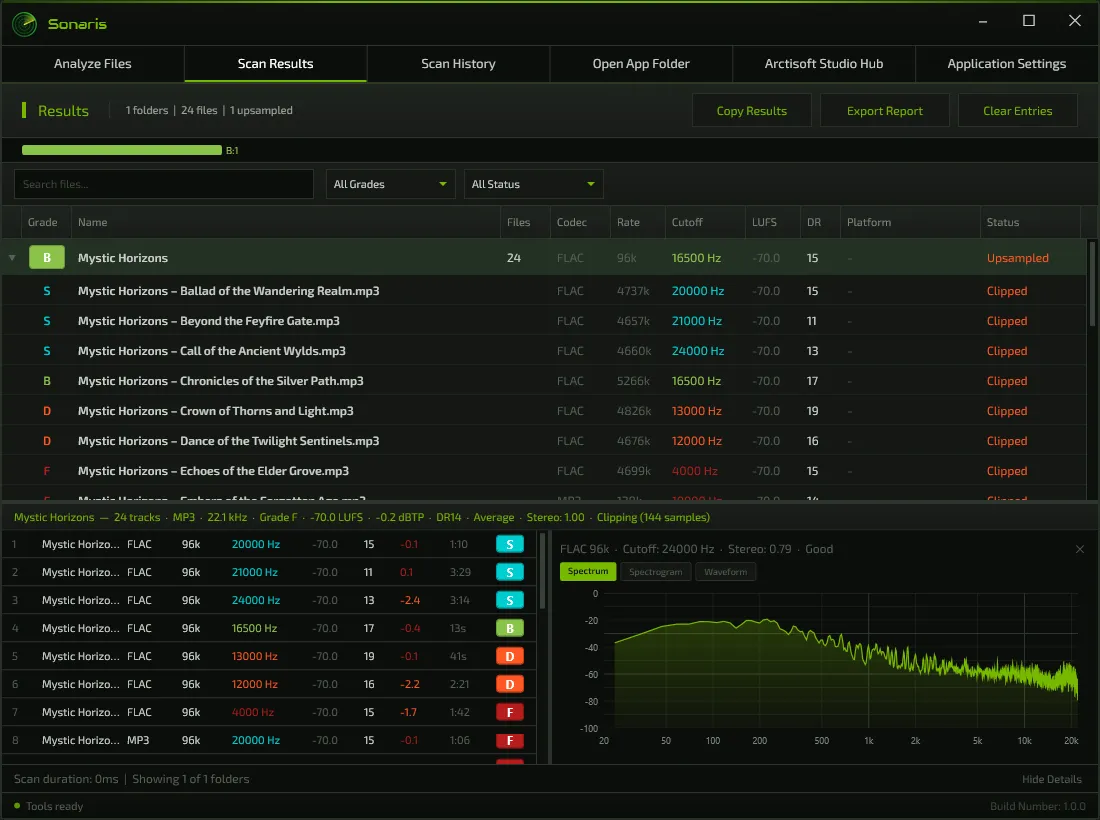
Sonaris folder result view
A folder under review
Batch scanning
Configurable samples per folder, parallel workers and a per-file timeout.
Visual evidence
Waveform, spectrum, spectrogram, grade distribution and loudness and dynamic-range histograms.
Filtering
Search by name; filter by format, grade or status; isolate issues in one step.
Reports
CSV with one row per folder, structured JSON with every measurement per track, and a formatted text report.
History
Earlier scans with their grade breakdowns and dates.
Source profiles
An optional mode that grades against the practical ceiling of a known source, from CD and vinyl to broadcast and legacy formats.
In practice

Who it is for

Catalogue ingest

Validate incoming libraries for lossy transcodes hidden in lossless containers.

Master delivery

Verify programme loudness, true-peak ceiling and clipping against a published specification before release.

A/B verification

Confirm that a new master matches a reference on loudness, dynamics and spectral extent.

Archive audits

Profile large historical collections with consistent, repeatable criteria.

Compatibility

Supported formats

The file types Sonaris works with in its current release.

Lossy
MP3MP2AACM4AOGGOGAOPUSWMAMPC
Lossless and PCM
FLACWAVAIFFAIFAPETTAWVCAFAUSND
DSD and high resolution
DSFDFFTHDMLPMKA
Surround and broadcast
AC3EAC3DTSDTSHD
Voice
AMRSPXGSM
Game and console
BRSTMBCSTMAT3ADXHCAVGMSPCNSFPSFMINIPSFXAVOC
Editions

Free to use

Sonaris is freeware. The complete application is available without payment.

Sonaris Freeware

Free

  • Loudness, true peak, dynamics, spectrum and stereo measurement
  • Delivery checks, reference comparison and defect evidence
  • Batch folder analysis with TXT, CSV and JSON reports
Install with Studio Hub
Everything included in Sonaris.
Feature Included
Analysis workspace
File and folder analysis Included
Waveform, spectrum and spectrogram evidence Included
Audio formats FFmpeg-supported input
Measurements
Integrated loudness and loudness range Included
True peak and dynamic observations Included
Stereo correlation and multichannel checks Included
Clipping, silence and technical defect findings Included
Spectral bandwidth and edge observations Included
Bit-pattern and provenance indicators Included
Delivery and comparison
Technical delivery checks Included
Audio reference comparison Included
File checksums and integrity evidence Included
Reports and workflow
Sessions and analysis history Included
Exportable analysis reports TXT, CSV, JSON

Technical measurements describe the decoded signal. Spectral and bit-pattern observations do not prove the original source, lossless ancestry or perceptual quality.

Use is governed by the License Agreement.

Requirements

System requirements

Minimum

  • Windows 10 (64-bit), version 1809 or later
  • Dual-core processor at 1.5 GHz
  • 4 GB RAM
  • 500 MB of free disk space

Recommended

  • Windows 10 or 11 (64-bit), version 21H2 or later
  • Quad-core processor at 2.0 GHz or higher
  • 8 GB RAM or more
  • 1 GB of free disk space on SSD

A native Windows application. The required runtime is included in the installer.

Sonaris uses FFmpeg and ffprobe for decoding and installs them automatically on first launch. Analysis depends on those tools recognising a file's codec.

Questions

Asked and answered

Does a grade prove where a file came from?

No. Technical measurements describe the decoded signal. Spectral and bit-pattern observations do not prove the original source, lossless ancestry or perceptual quality. They tell you where to look.

Does Sonaris certify a master for a platform?

No. Delivery Check reports measurements against the published targets of each profile. Loudness targets are full-programme measurements; long-form dialogue delivery still requires dialogue-gated verification.

What does Sonaris cost?

Sonaris is freeware. The complete application is available without payment.